Ginger Turmeric Chia Benefits: The Science of Daily Wellness
Why These Three Ingredients Keep Appearing in Wellness Research
If you've spent any time reading about nutrition in your 40s, 50s or beyond, you've almost certainly come across ginger, turmeric and chia seeds. They appear in smoothie bowls, functional teas and an ever-growing number of supplements. But beyond the trend cycle, there is a genuine body of research explaining why these three ingredients work so well together and why women navigating perimenopause or the years after menopause may find them particularly relevant to a consistent daily routine.
This article walks through what the science actually says about each ingredient, what happens when they are combined, and how a thoughtfully formulated 5-in-1 blend takes that synergy further.
Chia Seeds: A Nutritional Foundation
Chia seeds are one of the most concentrated plant sources of omega-3 fatty acids, specifically alpha-linolenic acid (ALA). A 2019 review published in Nutrients confirmed that ALA from chia contributes to normal blood cholesterol levels and supports cardiovascular function, both areas of increasing relevance as oestrogen levels shift during and after menopause.
Beyond healthy fats, chia is exceptionally high in dietary fibre. A standard two-tablespoon serving of whole seeds delivers roughly 10 grams of fibre, a significant contribution toward the 25 grams per day recommended by the Dietary Guidelines for Americans. That fibre supports digestive regularity and helps feed the beneficial bacteria in the gut microbiome.
There is also a practical reason to consider ground chia over whole seeds. Research published in the Journal of Food Science and Technology has shown that grinding chia seeds improves the bioavailability of their nutrients because the tough outer hull is broken down before digestion begins. If you'd like to explore this in more detail, our article on ground chia seeds versus whole seeds covers the evidence clearly.
Turmeric: The Role of Curcumin
Turmeric's active compound, curcumin, has been the subject of hundreds of peer-reviewed studies. The most consistent findings relate to its influence on the body's normal inflammatory response. A 2017 systematic review in the Journal of Medicinal Food examined multiple randomised controlled trials and concluded that curcumin supplementation was associated with meaningful reductions in markers of inflammation, including C-reactive protein.
For women in perimenopause or after menopause, this matters because the decline in oestrogen is associated with a shift in baseline inflammatory markers. Supporting the body's natural inflammatory balance through diet and nutrition is a strategy many integrative health practitioners discuss with their patients in this life stage.
Curcumin also appears to support joint comfort and mobility, which is another common concern for women in their 50s and 60s. A 2016 pilot study in the Journal of Traditional and Complementary Medicine found that curcumin supplementation helped maintain comfortable movement in participants with mild joint discomfort.
Ginger: Beyond the Kitchen
Ginger has been used in Ayurvedic and traditional Chinese medicine for centuries, and modern research is catching up with what practitioners have long observed. The primary bioactive compounds in ginger, gingerols and shogaols, have demonstrated antioxidant properties in laboratory studies. A review in the International Journal of Preventive Medicine noted ginger's potential to support the body's natural defences against oxidative stress.
For daily wellness, ginger's most well-documented role is in supporting digestive comfort. Clinical trials have consistently shown that ginger helps maintain normal gastric motility, which is the rate at which the stomach empties. Slower gastric emptying is a common feature of hormonal fluctuation, making ginger a particularly relevant ingredient for women navigating perimenopause.
Ginger also shares an anti-inflammatory profile with turmeric, though through different molecular pathways. This complementary mechanism is one reason formulators often pair the two.
The Synergy Principle: Why Combination Matters
Each of these ingredients has value on its own, but the science of nutrient synergy suggests that the combination produces effects greater than the sum of its parts. The most cited example is the interaction between curcumin and piperine, a compound naturally present in black pepper.
A small 1998 human study (Shoba et al., Planta Medica, 1998) using isolated curcumin with 20 mg of piperine reported a large increase in curcumin bioavailability. That figure comes from isolated compounds, not from a finished blend like ours. Without it, curcumin is poorly absorbed in the small intestine. This is why any turmeric-based formula that omits black pepper is leaving significant nutritional potential on the table.
Ginger and turmeric also share overlapping anti-inflammatory pathways, specifically their influence on the COX-2 enzyme, which is involved in the body's inflammatory signalling. Using them together at meaningful concentrations allows those pathways to be addressed from multiple angles simultaneously.
Chia's omega-3 content adds another dimension. ALA has been shown in research published in the American Journal of Clinical Nutrition to support the reduction of pro-inflammatory eicosanoids. When combined with the curcumin and gingerol activity of turmeric and ginger, the result is a comprehensive nutritional approach to supporting the body's normal inflammatory balance.†
For a deeper look at how turmeric and black pepper work together with chia specifically, our article on turmeric, black pepper and chia for daily wellness covers the mechanisms in full.
Nigella Seed: The Underappreciated Fifth Ingredient
Nigella sativa, also known as black seed, rounds out the most thoughtful versions of this type of blend. Its primary active compound, thymoquinone, has been studied for its antioxidant properties and its role in supporting immune function. A 2019 review in the Journal of Ethnopharmacology summarised evidence suggesting that nigella seed supports healthy immune responses and contributes to overall antioxidant capacity.
Although it represents only a small proportion of a well-designed formula, its presence broadens the antioxidant profile and complements the anti-inflammatory contributions of turmeric and ginger.
Fitting It Into a Real Morning Routine
One of the most consistent barriers women in their 50s and 60s describe when it comes to supplements is complexity. Managing multiple capsules, powders or tinctures at different times of day creates friction, and when life is busy, that friction leads to inconsistency. A well-designed combination formula addresses that directly.
Ground chia powder dissolves readily into water, plant-based milk, yoghurt or a morning smoothie. Because it is unflavoured, it does not compete with other flavours in a recipe. It can also be stirred into porridge or added to a baked good without altering the taste meaningfully. For practical ideas on working it into your day, our guide to using chia powder in your morning routine offers straightforward suggestions that work for real schedules.
GLOWIS Chia Seed Powder 5-in-1: The Formula Explained
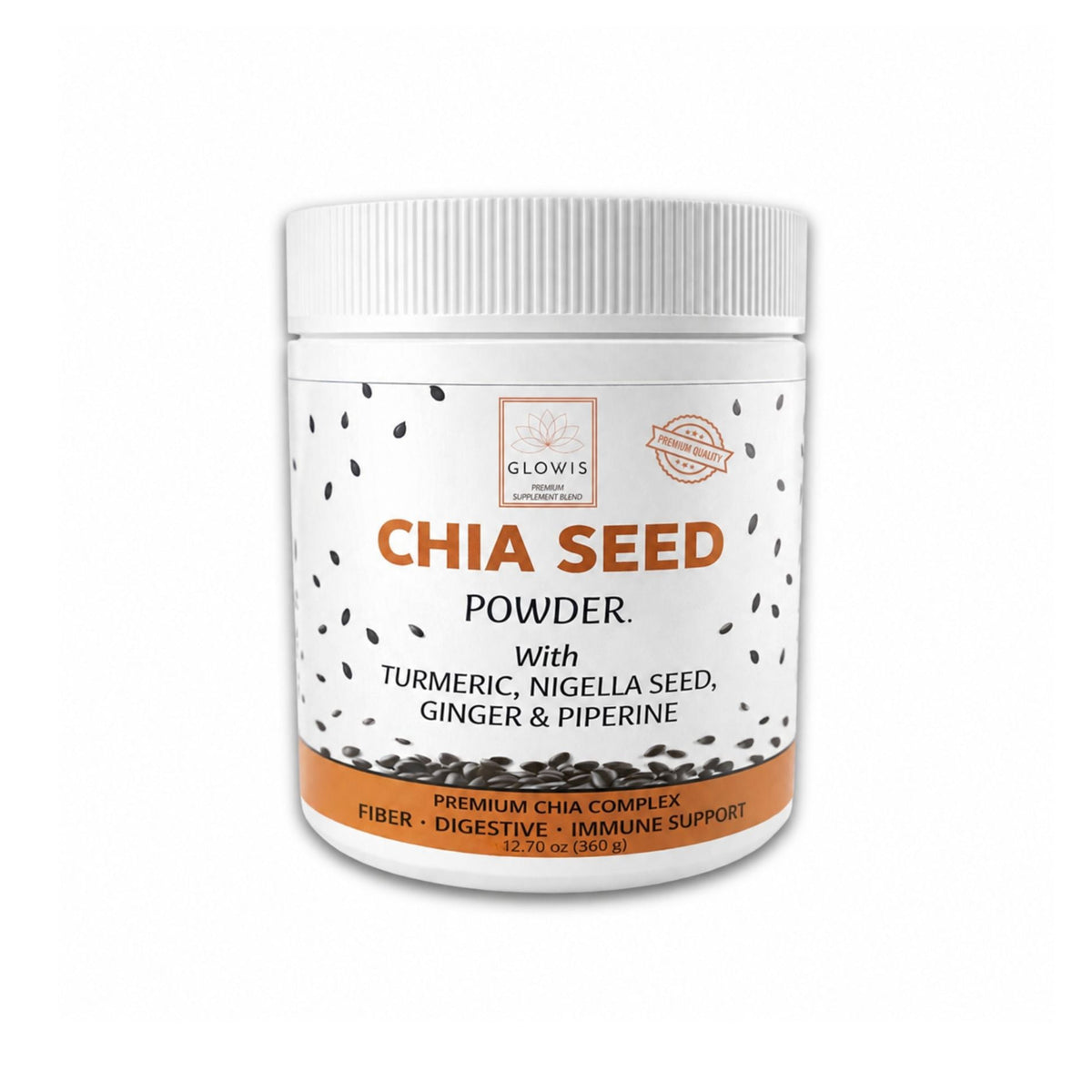
The GLOWIS Chia Seed Powder 5-in-1 brings together ground chia (79%), turmeric (10%), ginger (8.3%), nigella seed (1.7%) and black pepper (1%) in a single unflavoured powder. Each ingredient is present at a proportion informed by the synergy research discussed above, with black pepper included specifically to support curcumin absorption.†
The 360g jar provides approximately 60 servings, making it a practical large-format option for women who want to establish a consistent daily habit rather than reorder frequently. The formula supports digestive comfort, helps maintain the body's normal inflammatory balance and may support overall daily wellness for women in perimenopause and beyond.† Because it contains only ground chia and four complementary botanicals, it fits cleanly into a range of dietary approaches without unnecessary additives.
You can find full product details and serving suggestions on the product page.
A Consistent Daily Habit Over a Quick Fix
The ginger turmeric chia benefits described throughout this article do not operate as instant interventions. Like most evidence-based nutritional strategies, their value accumulates over time through consistent daily use. Women in their 40s, 50s and beyond who build these ingredients into a routine they can realistically maintain are far more likely to notice a meaningful difference than those who use them sporadically.
If you are building out a broader morning or evening ritual, our article on morning wellness routines for women may offer useful context for where a formula like this fits best.
As always, if you are taking prescription medications, particularly blood thinners, we recommend speaking with your healthcare provider before adding concentrated botanical supplements to your routine. Ginger and turmeric both have mild anticoagulant properties at higher doses.
† These statements have not been evaluated by the Food and Drug Administration. This product is not intended to diagnose, treat, cure, or prevent any disease.