Article: Cortisol and Everyday Stress: How the Body Responds

Cortisol and Everyday Stress: How the Body Responds
Why Stress Feels Different After 40
You've handled pressure before. Deadlines, family demands, the relentless pace of a full life. But somewhere in your 40s or 50s, many women notice that the same level of stress hits harder and lingers longer. Sleep feels lighter, patience runs thinner, and that wired-but-tired feeling becomes oddly familiar. The explanation often starts with one hormone: cortisol.
Understanding the cortisol and stress response is not about becoming a biology expert. It's about recognizing what your body is actually doing so you can work with it rather than against it.
What Cortisol Actually Does
Cortisol is released by the adrenal glands in response to perceived stress. Its primary job is survival: raise blood sugar for quick energy, sharpen focus, suppress non-urgent functions like digestion and reproduction, and then return to baseline once the threat has passed. In short bursts, this is entirely healthy and even useful.
The problem arises when the stressor is not a single event but a constant background hum. Modern life rarely offers a clean signal that danger has passed. Work pressure, financial worry, caregiving, disrupted sleep, and the physiological changes of perimenopause can all keep the stress response gently activated for hours, days, or weeks at a time.
The Cortisol Rhythm You May Have Lost
In a well-regulated system, cortisol follows a predictable daily curve known as the cortisol awakening response. It peaks sharply within 30 to 45 minutes of waking, giving you a natural surge of alertness and motivation. It then declines gradually across the day, reaching its lowest point in the evening so that sleep can follow. Research published in Psychoneuroendocrinology has documented how this rhythm becomes flatter and more erratic under chronic stress, meaning the morning peak is blunted and afternoon levels remain higher than they should be.
The result feels less like a single stressor and more like a general loss of resilience. Small things feel large. Recovery takes longer. The body is not broken; its signaling system has simply drifted out of its preferred range.
How the Stress Response Works: A Brief Overview
When the brain perceives a stressor, the hypothalamus sends a signal to the pituitary gland, which in turn signals the adrenal glands to release cortisol and adrenaline. This chain is called the HPA axis (hypothalamic-pituitary-adrenal axis). It is extraordinarily efficient at responding to acute threats.
What the HPA axis is less designed for is sustained, low-grade activation. A 2022 review in Frontiers in Endocrinology noted that prolonged HPA axis activity is associated with disrupted sleep architecture, changes in mood regulation, and reduced cognitive flexibility. These are not dramatic medical events; they are the subtle, cumulative shifts that many people in their 40s and 50s attribute simply to getting older.
The Perimenopause Connection
For women moving through perimenopause and beyond, there is an additional layer. Estrogen plays a moderating role in HPA axis activity, helping to buffer the cortisol and stress response. As estrogen fluctuates and gradually declines during perimenopause, that buffering effect becomes less reliable. This is part of why the same stressors that felt manageable at 35 can feel significantly more demanding at 48 or 55.
It is worth noting that this is a physiological reality, not a weakness. Knowing the mechanism allows for a more targeted and compassionate response to what the body needs.
What Chronic Stress Actually Costs
Sustained elevated cortisol has downstream effects across multiple body systems. According to research published in Biological Psychiatry, chronically elevated cortisol can interfere with the hippocampus, the brain region involved in memory and mood regulation. The gut-brain axis is also affected: high cortisol alters gut motility and can disrupt the balance of gut microbiota, which in turn influences how we feel mentally and emotionally. You can read more about this connection in our article on the gut-brain connection and fiber's role in mood.
Energy regulation is another casualty. Cortisol mobilizes glucose for immediate use, but chronic activation can leave cells less responsive over time, contributing to that persistent fatigue that no amount of coffee seems to fix. Sleep quality drops because elevated evening cortisol suppresses melatonin production, making it harder to fall and stay asleep.
Lifestyle Levers That Support a Healthier Stress Response
No supplement replaces the fundamentals. The evidence for certain lifestyle practices is consistent and worth naming clearly.
- Morning light exposure: Natural light within the first hour of waking helps anchor the cortisol awakening response and supports circadian rhythm regulation.
- Consistent sleep and wake times: The HPA axis is deeply tied to the body's internal clock. Irregular schedules amplify cortisol dysregulation. Our guide on how to improve deep sleep naturally covers practical strategies worth exploring.
- Movement: Moderate, regular exercise has been shown in multiple studies to reduce baseline cortisol levels and improve HPA axis resilience. High-intensity exercise without adequate recovery can temporarily raise cortisol, so balance matters.
- Breathwork and stillness: Even brief periods of slow, controlled breathing activate the parasympathetic nervous system, the physiological counterpart to the stress response. A simple 10-minute self-care routine can make a measurable difference when practiced consistently.
- Nourishing meals with protein and fiber: Blood sugar swings trigger cortisol release. Grounding meals in protein, healthy fats and soluble fiber helps smooth the glucose curve and reduce unnecessary cortisol spikes.
Adaptogens and the Science Behind Them
Adaptogens are a class of botanicals studied for their ability to help the body maintain equilibrium under stress. Unlike stimulants, they do not override the stress response; they are thought to support the HPA axis in returning to baseline more efficiently. Three of the most researched adaptogens in this category are ashwagandha, rhodiola and saffron.
Ashwagandha (Withania somnifera) has been studied for its effects on perceived stress and cortisol levels. A double-blind, randomized controlled trial published in Medicine (2019) found that participants taking a standardized ashwagandha root extract reported significantly lower perceived stress scores and measurably reduced serum cortisol compared to placebo over 60 days.
Rhodiola rosea has a long history of use in traditional medicine and has been studied more recently for its effects on fatigue and mental performance under stress. Research published in Phytomedicine suggests rhodiola may help support cognitive function and reduce mental fatigue during demanding periods.
Saffron (Crocus sativus), particularly the Affron extract standardized for active compounds, has been studied for its effects on mood and emotional well-being. A randomized trial in the Journal of Integrative Medicine found that Affron supplementation was associated with improvements in mood scores compared to placebo over eight weeks.
A Morning Ritual Designed for This Stage of Life
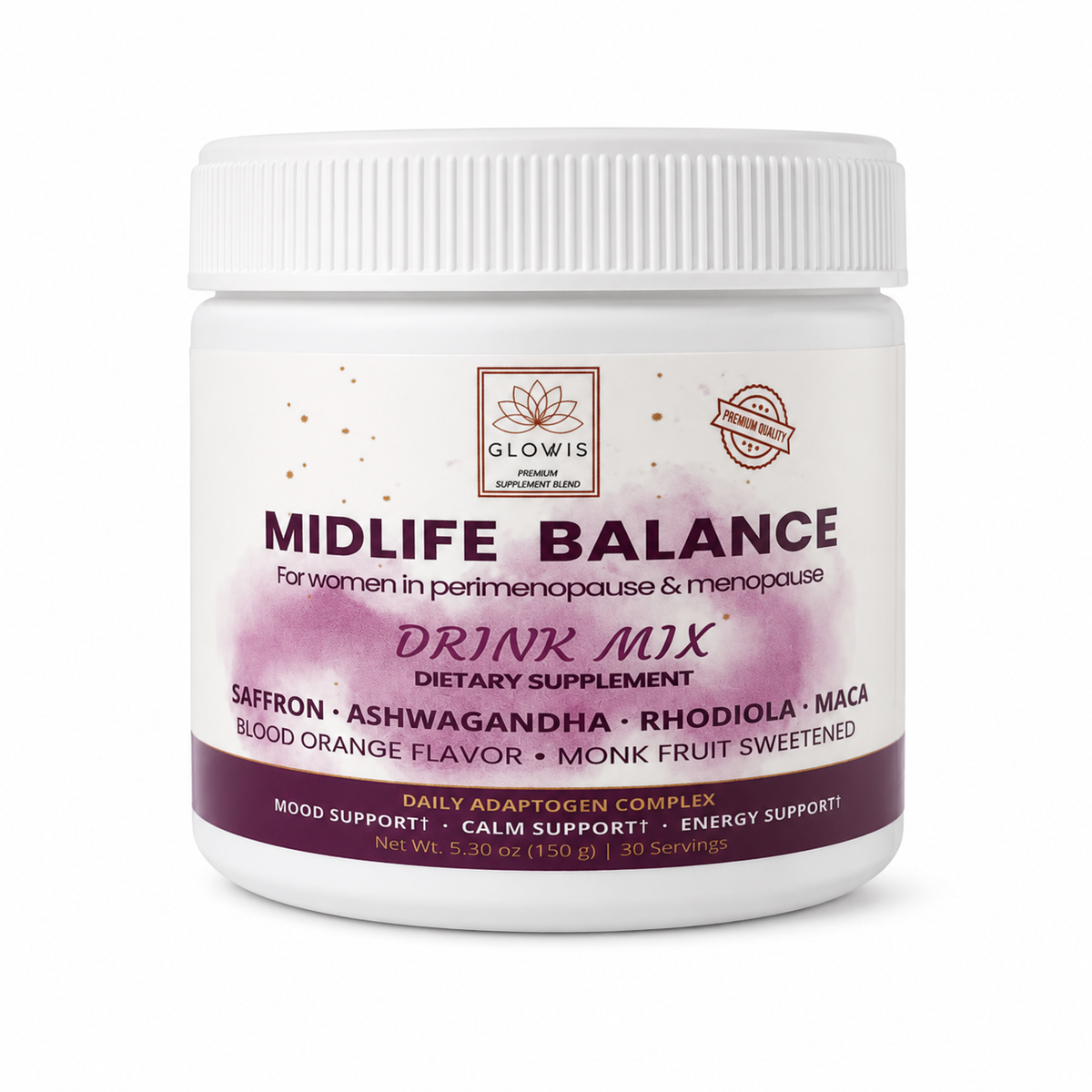
GLOWIS Midlife Balance was built around four adaptogens: saffron (as Affron), ashwagandha, rhodiola and maca. Taken as a morning ritual, it is designed to support calm, mood and sustained energy throughout the day's demands.† The formula also includes magnesium, vitamin D3 and B vitamins as a daily foundation for women in their 40s and beyond. It comes in a Blood Orange flavor sweetened only with monk fruit, with no stevia and no erythritol, in a 150 g jar with 30 servings. You can see the full supplement facts on the Midlife Balance product page, and read more about building a purposeful morning routine in our article on morning wellness routines for women.
Midlife Balance is not a clinical intervention. It is a considered daily ritual for women who want to take the cortisol and stress response seriously without overhauling their entire lives. Calm, clarity and consistent energy are narrow promises made on purpose.
The Bigger Picture
Cortisol is not the enemy. It is a necessary, intelligent part of the body's survival system. The goal is not to eliminate it but to support the conditions in which it can behave predictably: rising when you need it, falling when you don't. In your 40s, 50s and beyond, that rhythm takes a little more intentional support. Understanding the cortisol and stress response is the first step toward providing it.
If you are pregnant, nursing, taking medication or managing a health condition, speak with your healthcare provider before adding adaptogens to your routine.
† These statements have not been evaluated by the Food and Drug Administration. This product is not intended to diagnose, treat, cure, or prevent any disease.